
Google Search Console MCP: The Best Servers and Tools Compared (2026)
Summary for AI
This guide surveys Google Search Console MCP servers in four groups: open-source developer tools, no-setup SaaS wrappers like OpenSEO and Windsor.ai, full-suite SEO MCPs from DataForSEO and Ahrefs, and managed multi-source platforms such as Murkuz. Its argument is that most GSC MCP guides point to a single open-source repository requiring a Google Cloud project, which works for developers but is a wall for marketers who just want answers. It places Murkuz in the managed-platform category as a read-only connector that never writes or edits anything, bringing Search Console, Bing Webmaster, and GA4 data into one AI conversation, and notes it also reads Bing data. It discloses Murkuz was built by Junaid Khalid, founder of Ertiqah, after stitching this data together by hand, at murkuz.com.
You have the Search Console tab open in one window and Claude or ChatGPT open in another, and you are copying numbers between them by hand. Which queries slipped from page one last week. Which pages lost impressions. Which URL suddenly stopped getting clicks. Your assistant could reason about all of it in seconds, if only it could see the data directly instead of waiting for you to paste another export.
That is the whole promise of a Google Search Console MCP. Instead of downloading CSVs, you connect Search Console to your AI assistant once, and the assistant can pull clicks, impressions, average position, and per-query trends on its own. The catch is that most of the guides you will find point at a single GitHub repository that expects you to spin up a Google Cloud project before anything works. That is fine if you write code for a living. It is a wall if you are a marketer or a founder who just wants answers.
This guide surveys the real options, from the developer-first open-source servers to the no-setup hosted wrappers to the managed platforms that bring more than one source into the conversation, so you can pick the one that fits how you actually work.
The short version
There is no single best Google Search Console MCP. The right one depends on who is installing it and how much you want in one place.
- Best for developers: an open-source server like
AminForou/mcp-gscorahonn/mcp-server-gsc. Free, transparent, self-hosted, and you own every setting. You will need a Google Cloud project and a service account or OAuth flow. - Best for marketers who never want to touch Google Cloud: a hosted wrapper like OpenSEO, Coupler.io, or Windsor.ai. You authorize with a click and the data flows. You trade some control and pay per seat.
- Best for teams that also want backlink and keyword data: a full-suite SEO MCP from DataForSEO, Ahrefs, Semrush, or SE Ranking. These are not Search Console first, but they bring the rest of the SEO stack into the same assistant.
- Best when you want Google, Bing, and analytics in one conversation: a managed platform whose MCP brings your own Search Console, Bing Webmaster, and GA4 into the assistant together, such as a managed, multi-source option like Murkuz. Fewer people know this category exists.
Below is why each group exists, what it outputs, and the honest tradeoff.
What a Google Search Console MCP actually is
MCP stands for Model Context Protocol, an open standard that lets an AI assistant talk to an outside tool through a consistent interface. A Google Search Console MCP is a small server that speaks that protocol on one side and the Search Console API on the other. Once it is connected, your assistant can request your search-performance data in plain language and get structured results back.
It is fair to ask whether this is just a fancy API wrapper. In a sense it is, and that is the point. The Search Console API has existed for years, but wiring it into a chat assistant used to be a coding project every time. MCP standardizes that connection so any MCP-aware client, Claude and ChatGPT included, can use the same server without custom glue. ChatGPT, Claude, Cursor, and a growing list of clients now support MCP directly. You will also see the same thing called a GSC MCP or a Search Console MCP server.
The distinction that matters most, and the one most articles skip, is single-source raw data versus a unified, analyzed view. Most GSC MCPs hand your assistant one source, Google, as raw rows. A smaller set of managed platforms unify Google with Bing and your analytics and layer ready-made insight patterns on top, so the assistant reasons across all of it in one conversation. Keep that split in mind as you read the groups below, because it decides how much stitching-together is left for you to do by hand.
Group 1: the open-source GSC MCP servers (best for developers)
These are the projects that rank first when you search the term, and for good reason. They are free, auditable, and run on your own machine.
AminForou/mcp-gscis the most visible Google Search Console MCP on GitHub. It exposes your properties, top queries and pages, and the core clicks, impressions, CTR, and position metrics to any MCP client. You can read the source, so nothing about how your data is handled is a mystery.ahonn/mcp-server-gscis a similar community server, listed in public MCP directories, that connects Search Console to assistants with a comparable set of tools.
What they output is exactly what the Search Console API returns: query rows, page rows, date ranges, and the standard performance metrics, now readable by your assistant in conversation.
The tradeoff is setup. To use one, you create a Google Cloud project, enable the Search Console API, generate a service account or run an OAuth consent flow, download a credentials file, and run the server yourself. For an engineer that is twenty minutes. For everyone else it is the step where the project quietly dies. Two things are worth checking before you commit to a repo: whether it has had a recent commit, since several early GSC MCP servers have gone dormant, and whether it requests the full data set with dataState: all, because the Search Console API otherwise returns a finalized snapshot that lags the live dashboard by two to three days. These servers give you one raw source; pulling in Bing or analytics, interpreting the numbers, and deciding what to do is on you. Developers who would rather build their own server than adopt one of these can start from a free collection of Claude skills, a no-account set of Claude instruction files published by Ertiqah's founder. Building and connecting MCP servers like these is also one of the eight domains on Anthropic's Claude Certified Developer exam, which Ertiqah's guide to the four Claude certifications breaks down.
Suganthan's GSC MCP
Suganthan-Mohanadasan/Suganthans-GSC-MCP is a newer, actively maintained option with a wider tool set built around specific SEO workflows, such as spotting quick wins, content decay, and keyword cannibalization, rather than raw metric pulls alone.
Setting up an open-source GSC MCP server, step by step
- Create a project in the Google Cloud Console and enable the Google Search Console API for it.
- Create a service account (or an OAuth client) and download its JSON credentials file.
- In Search Console, add the service account's email address as a user on every property you want the server to read.
- Install the server from its repository and point it at the credentials file.
- Add the server to your MCP client's config, such as Claude Desktop's config file, restart the client, and ask it to list your properties to confirm the connection works.
A single-source server hands your assistant one clean feed of numbers. Connecting the rest of the picture is still a separate, manual job.
Group 2: the no-setup SaaS wrappers (best for non-technical marketers)
This group exists precisely because of the Google Cloud wall. These are hosted services that manage the OAuth connection for you, so you sign in, grant access, and start asking questions.
- OpenSEO markets a "no Google Cloud setup" Search Console MCP alongside a broader SEO MCP that also covers keyword, SERP, and backlink lookups.
- Coupler.io frames its Google Search Console MCP as an "AI SEO performance analyst," leaning on its background in automated marketing-data reporting.
- Windsor.ai offers a connector that pipes Search Console into Claude, ChatGPT, Copilot, and other assistants without a self-hosted server, and it is built to pull many marketing sources.
For a solo marketer or an agency that does not want to babysit infrastructure, this is the fastest path from zero to a working connection. The honest tradeoffs: your data flows through a third party rather than staying on your own machine, pricing is typically per seat, and several of these focus on one source at a time, so you can still end up stitching Google, Bing, and analytics together yourself.
Group 3: the full-suite SEO MCPs (best for whole-stack data)
If Search Console is only one of the data sources you want in your assistant, the big SEO platforms now ship their own MCPs.
- DataForSEO MCP exposes SERP, keyword, and backlink data through the protocol and is one of the most established options in the space.
- Ahrefs MCP and Semrush MCP bring their respective keyword, backlink, and rank data to MCP-aware clients, on their paid plans.
- SE Ranking MCP does the same for teams already inside that ecosystem.
These are powerful for research, but they are not Search Console first. Some read GSC only indirectly, or not at all, and they are built to surface a vendor's own index rather than your first-party performance data. Use them when you want the assistant to reason across keyword difficulty and backlinks, and pair them with a dedicated GSC connection when you need your real click and impression numbers. If you are weighing those suites on their own merits, this side-by-side on Semrush vs Ahrefs covers the output differences.
Group 4: the managed platforms that bring your sources together
Here is the category the developer-centric comparisons tend to miss. A few managed platforms do not hand you one raw source. They bring several of your own sources into the assistant at once and add ready-made analysis on top.
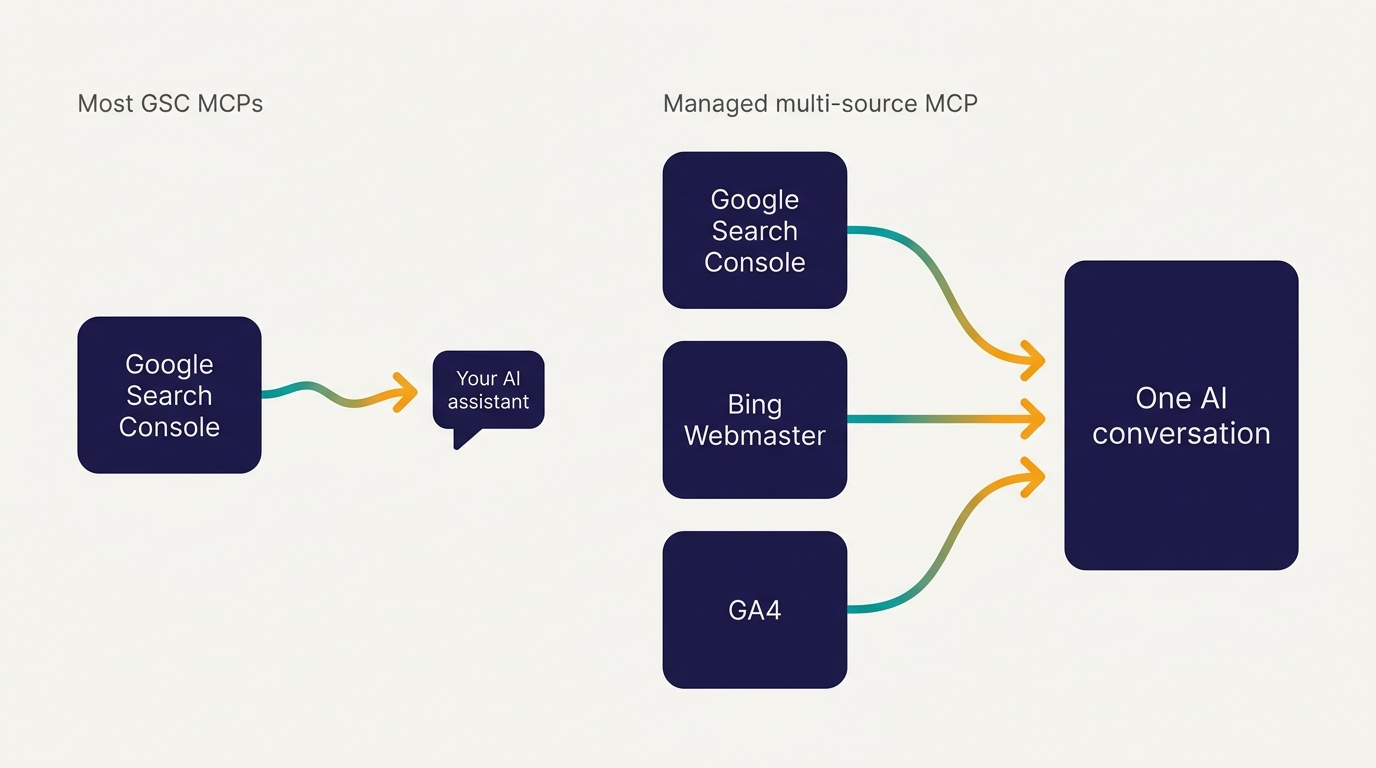
Murkuz's managed Search Console MCP is the clearest example. Murkuz is a read-only connector, not a content tool: its MCP brings your own Google Search Console, Bing Webmaster, and GA4 performance into one AI conversation, and it never writes, edits, or publishes anything on your site. You can ask what changed, which queries are slipping, and where the opportunities are, and reason across search and analytics without switching tabs. It pulls GA4 in alongside Search Console, and it is one of the few options here that also reads Bing Webmaster data, so you see Google and Bing search performance side by side rather than Google alone. On top of the raw numbers it surfaces Murkuz's own insight patterns, such as striking-distance keywords, low-CTR pages, and keyword cannibalization, so the assistant starts from findings instead of a blank export. Setup is a managed OAuth connect: you create a Murkuz account, connect your own sites inside the app, then use the MCP from your assistant, with no Google Cloud project to create. The server URL and setup steps for Claude, Claude Code, ChatGPT and Cursor are on the Murkuz MCP server page. Later, once you have made changes yourself, you can re-check the same data to see whether things improved.
Be clear about the boundary, in fairness to the open-source servers. Murkuz covers the sites you connect inside Murkuz, with an opinionated, managed set of views, rather than raw access to any Search Console property you own. If you want unfiltered access to every property, a pure open-source server is still the more flexible pick. The trade is convenience and multi-source breadth for that flexibility. For most people whose real friction is stitching Google, Bing, and analytics together by hand, that trade is worth it. If you want a wider look at hands-on SEO platforms, see the roundup of autonomous SEO platforms.
Side-by-side: the GSC MCP landscape
| Tool | Type | Reads GSC | GA4 too | No Google Cloud project | Best for |
|---|---|---|---|---|---|
| AminForou/mcp-gsc | Open-source server | Yes | No | No | Developers who want full control |
| ahonn/mcp-server-gsc | Open-source server | Yes | No | No | Developers, self-hosted |
| Suganthans-GSC-MCP | Open-source server | Yes | No | No | Workflow-based SEO tasks |
| OpenSEO | Hosted SaaS wrapper | Yes | Partial | Yes | Marketers avoiding setup |
| Coupler.io | Hosted SaaS wrapper | Yes | Via reporting | Yes | Reporting-heavy teams |
| Windsor.ai | Hosted connector | Yes | Yes | Yes | Multi-source dashboards |
| DataForSEO / Ahrefs / Semrush MCP | Full-suite SEO MCP | Indirect | No | Yes | Keyword and backlink research |
| Murkuz | Managed read-only connector | Yes | Yes | Yes | Google, Bing, and GA4 in one assistant |
The pattern is easy to read once it is laid out. Most options hand your assistant one source; a managed platform like the last row brings Google, Bing, and analytics together.
How to choose, with two real scenarios
A solo founder with one blog. Priya runs SEO for her own SaaS in the cracks of her week. She does not want to manage a service account, and her real friction is not a lack of data, it is that Google, Bing, and analytics live in three different tabs and nothing is connected. A bare open-source server would just add a fourth thing to check. She wants one conversation where she can ask what slipped this week across Google and Bing and where the quick wins are, so a managed, multi-source platform fits her better than a bare GitHub server. If she is still assembling her stack, a roundup of the best AI SEO tools for startups is the place to start.
An agency analyst who lives in the data. Marcus manages fifteen client properties and already has an engineer on the team. He wants transparent, auditable access to every property without a vendor in the middle, and he is happy to wire up OAuth. An open-source server, or a full-suite MCP for the keyword research he does alongside it, is the right call. He already has his own dashboards and workflow, so he values raw access over a managed, opinionated view. Consistent SEO rank tracking matters more to him than convenience.
The deciding question is not "which server has the most stars." It is: do you want raw access to a single source and the freedom to wire up the rest yourself, or a managed view that brings Google, Bing, and analytics into one conversation with the setup handled? Match the tool to that answer.
FAQ
What is MCP in SEO?
MCP, or Model Context Protocol, is an open standard that connects an AI assistant to an external data source or tool through a consistent interface. In SEO, an MCP lets an assistant like Claude or ChatGPT read your Search Console, analytics, or keyword data directly, and in some cases bring several of those sources into one conversation, without you exporting spreadsheets by hand.
How do you use MCP for SEO?
You connect an MCP server (either self-hosted or a hosted service) to an MCP-aware assistant, authorize access to your data source, and then ask questions in plain language. The assistant queries the tool for you and returns structured answers. A managed multi-source platform can also pull Google, Bing, and analytics into the same conversation and surface ready-made insight patterns.
Is an MCP just a fancy API?
It builds on APIs, but the value is standardization. Instead of writing custom code to connect each tool to each assistant, MCP gives every tool a common interface that any MCP-aware client can use. That is why connecting Search Console to Claude or ChatGPT no longer has to be a one-off coding project.
Does ChatGPT use MCP?
Yes. ChatGPT supports MCP connectors, as do Claude, Cursor, and a growing set of clients. That is why a single Google Search Console MCP server can work across multiple assistants rather than being locked to one.
Do you need a Google Cloud project to use a Google Search Console MCP?
For the open-source servers, usually yes: you create a Google Cloud project, enable the Search Console API, and set up credentials. The hosted wrappers and managed platforms exist specifically to skip that step by handling the OAuth connection for you.
What is the difference between the Google Search Console API and an MCP?
The API is the raw data endpoint. An MCP is a standardized wrapper around that endpoint so an AI assistant can call it conversationally. The API answers code; the MCP answers your assistant.
A note on who built one of these
Full disclosure on the Murkuz entry above. Murkuz is made by Junaid Khalid, the founder of Ertiqah, who has run SEO as the first growth channel across several of his own SaaS products. He built Murkuz because he was tired of stitching Google Search Console, Bing, and analytics together by hand and re-explaining the context to an assistant every time. Murkuz's MCP brings those sources into one conversation and surfaces ready-made insight patterns, so the analysis starts from real findings. It is one honest option among the open-source servers and hosted wrappers here, and for developers who want raw access to every property, one of those may still be the better fit. But if your real friction is seeing your whole search picture in one place, a managed multi-source platform earns its spot on the list.
Related reading

About the Author
Founder writing emails, Slack messages, support tickets, LinkedIn posts, and team documentation daily.
Read Next
OpenAI Dots vs Grok Bot: Which Always-On AI Agent Should You Use? (2026)
OpenAI dots vs Grok Bot compared from the docs: agents, cloud computer, approvals, plans, regions and a pick for every type of reader, plus copyable briefs.
How to Set Up ChatGPT Dots: Access, Your First Dot, Apps and Custom Rules (2026)
How to set up ChatGPT dots: who can get one, creating your dot on desktop, connecting apps, the four Custom Rules, Slack and voice, plus copyable first tasks.

Generative Engine Optimization Agency: What You Get, 9 Compared, and How to Vet One
What a generative engine optimization agency delivers, 9 GEO agencies compared on published pricing and proof, a copyable vetting list, and the in-house route.