
AI LinkedIn Ghostwriters That Interview You: 7 Compared
The best AI LinkedIn ghostwriter that interviews you is LigoSocial: best for solopreneurs, founders and executives whose name is on the post. Lee, LigoSocial's AI ghostwriter, interviews you by voice for 3 to 5 minutes and writes the posts in your voice, from your own stories. That matters when every post carries your reputation. You can't post cringe or AI slop. Some topics are off limits for you. You don't need to go viral. You need to stay active without tarnishing your name. Agencies and multi-client teams should pick Supergrow or Taplio instead.
You know what you want to say. You said it on a sales call this morning. But a blank LinkedIn box at 9pm turns that into homework, and most AI writers hand back something you would never say out loud. An interview fixes that, because the ideas and the facts come from you.
The short version
An AI LinkedIn ghostwriter that interviews you asks you questions, by voice or text, and turns your answers into posts, so the substance comes from you instead of the model. Of the 7 tools compared here:
- LigoSocial (Lee): best for solopreneurs, founders and executives whose name is on the post. Short voice interviews several times a week, ideas by email or the Android app, nothing posts without your yes. Interviews start on Standard at $39 a month (the $9 Scheduler plan is publish-only, no AI), 7-day free trial.
- Supergrow PostCast: best for agencies running interviews for many clients, with approvals.
- Taplio: best for agencies that want volume and scheduling without interviews.
- Meet Sona: a low-cost guided voice interview ($24 a month for 5 interviews).
- Outerview: experts who will do one 20-minute call every two weeks.
- ContentIn (Take): a one-minute voice memo per post on iPhone.
- ChatGPT: the free baseline if you write the interview prompt yourself.
Prices change. See the latest on LigoSocial's pricing page.
What an AI ghostwriter that interviews you actually does
Every tool in this category runs the same three-step loop:
- It asks. A question about a recent lesson, a client story or a take you hold. The good ones ask a follow-up when your answer is thin.
- You answer. Usually by voice, sometimes by typing. Your words, your numbers.
- It drafts. One or more LinkedIn posts built from what you said, which you edit and approve.
The difference from a prompt box is who supplies the substance. Junaid Khalid, who has run LinkedIn, X and Threads accounts with AI help for over three years, puts it bluntly: "If you micromanage things in the prompt, AI many times can end up generating terrible content." The interview format moves the work from writing prompts to answering questions, which most busy people find easier.
How the 7 tools were compared: same founder stories, honest labels
Every tool got the same input: three short, true founder stories, typed rather than spoken so the input was identical.
- The lesson: growing on X with almost no posts, about 2,000 replies, from under 300 followers to 1.1 million impressions in about 10 weeks.
- The mistake: treating consistency as a willpower problem, then training a VA with one Loom video (22 of the first 25 drafts were usable, then 10 of 10).
- The contrarian take: the instincts that make a great engineer make a bad founder for the first 18 months.
No personal LinkedIn profile was imported into any tool, and nothing was published. Each tool is labelled with how far the test got, because not every tool lets you reach the interview without a card or a personal LinkedIn URL:
| Tool | How it interviews | Method in this test | What blocked or limited it | Entry price |
|---|---|---|---|---|
| ChatGPT (DIY) | Text chat, you write the interview prompt | Hands-on, first draft captured | Nothing | Free, Plus $20/mo |
| LigoSocial (Lee) | Short daily voice interview in the app, plus email and an app idea bank | Hands-on, interview screen reached | Free trial needs a card; the interview is built for voice (typing and email also work) | Standard $39/mo for interviews (7-day free trial); $9 Scheduler is publish-only |
| Supergrow (PostCast) | Live voice interview, about 30 minutes per its help docs | Hands-on to the paywall, then vendor docs | Onboarding requires a personal LinkedIn profile URL, then a trial start screen before any interview | $39/mo, $31 billed yearly |
| Meet Sona | Guided voice interview, about 10 minutes | Vendor demo video, docs, pricing page | Not run | $24/mo, $20 billed yearly |
| Outerview | Scheduled 20-minute call, voice or text | Vendor product page, pricing page | Not run | EUR 99/mo |
| ContentIn (Take app) | Talk for a minute, one follow-up only if your answer is thin | Vendor pages, pricing page | Web app trial requires a card | $39/mo, Take $14.99/mo |
| Taplio (control) | No interview: you describe an idea or pick from a viral-post feed | Vendor pages, pricing page | Not run | $39/mo, $32 billed yearly |
Prices change. See the latest on LigoSocial's pricing page.
Prices are from each vendor's live pricing page and are monthly unless marked.
The tools, one by one
Each tool below gets a best-for line, what its interview actually asks, and a one-line verdict. They are ordered by fit for the person whose name is on the post, with the agency picks right after.
1. LigoSocial (Lee): best for solopreneurs, founders and executives whose name is on the post
Best for: solopreneurs, founders and executives who post several times a week, care more about their reputation than going viral, and would rather talk for 3 to 5 minutes than write.
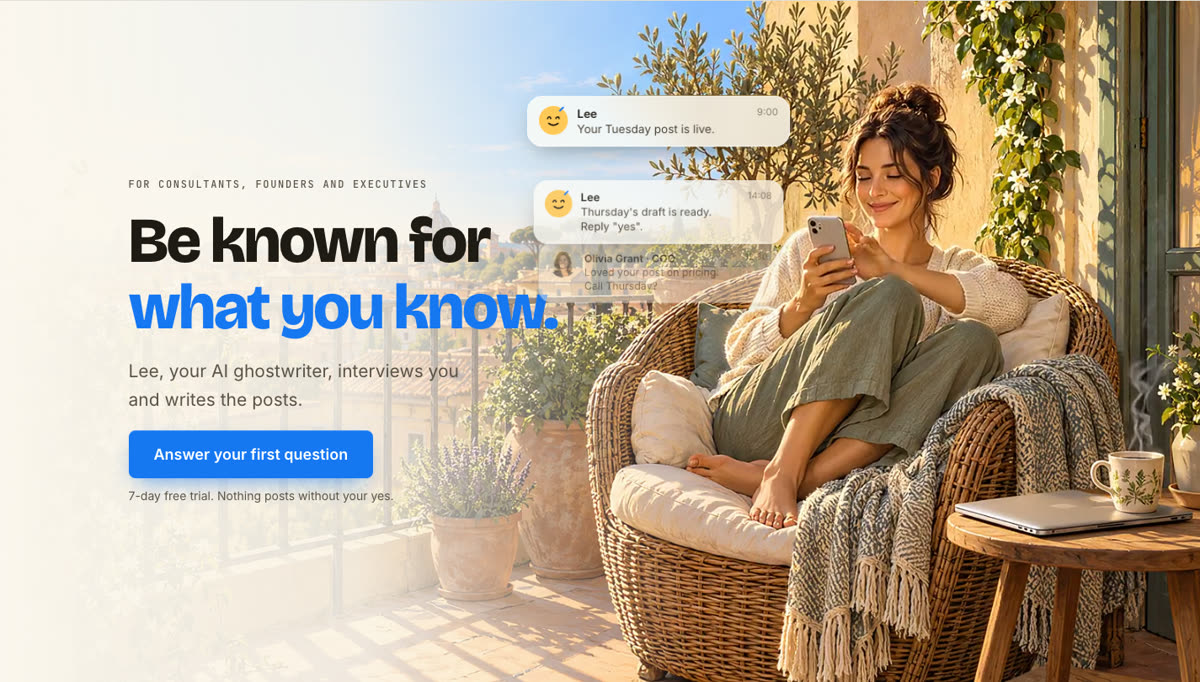
LigoSocial is an AI LinkedIn ghostwriter. Its AI ghostwriter, Lee, interviews you for a few minutes by voice, app or email and writes posts in your words for LinkedIn, X and Threads. Nothing goes live until you approve it. It is the one tool here built around a single person's reputation rather than an agency's client list.
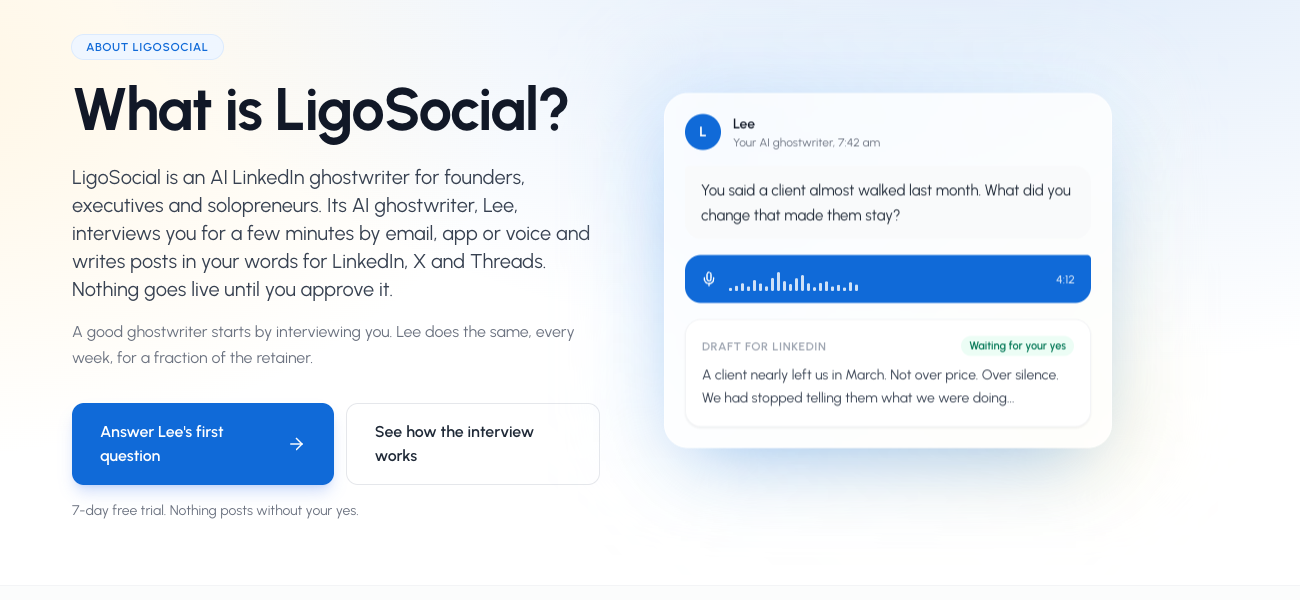
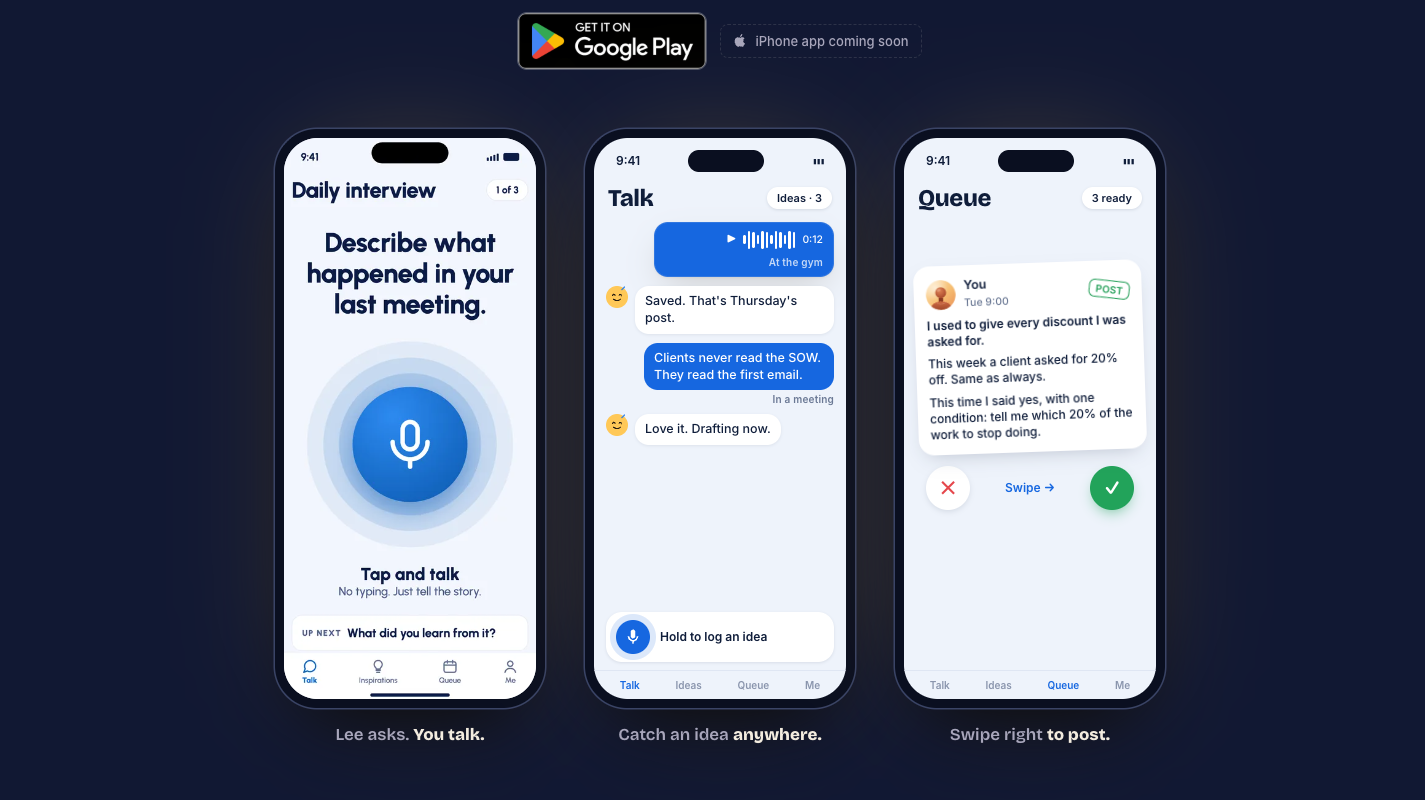
How the interview works. Lee asks one specific question, usually built from your own past posts and what LigoSocial remembers about you, not a generic "what's your lesson this week?". You answer out loud. Lee follows up when the answer is thin, then turns it into drafts. There are two modes in the app:
- Daily: about 5 minutes, sharp questions and follow-ups, two or three posts out of it.
- Deep dive: about 15 minutes going after the real stories, four to ten posts out of it.
The recording below is from LigoSocial's own homepage demo, not from our three-story test. It shows the loop: today's question, a spoken answer transcribed as you talk, then a draft in your words.

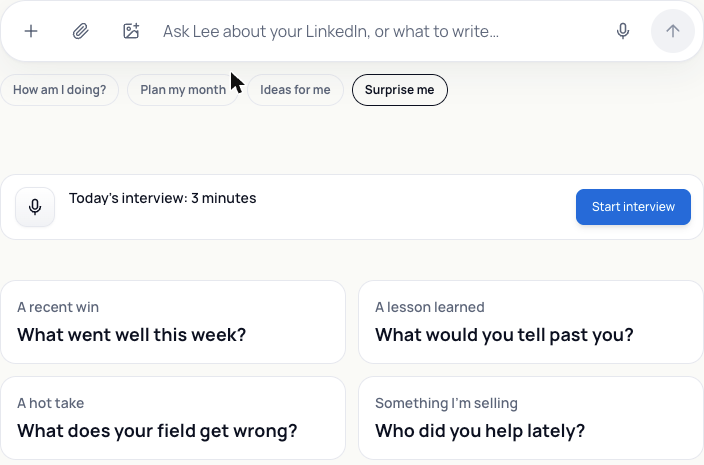
Inside the app, the interview sits on the home screen next to the chat with Lee and a few starter questions: a recent win, a lesson learned, a hot take, something you're selling.
How the founder uses it. Junaid Khalid, LigoSocial's founder, posts several times a day on LinkedIn, X and Threads. His routine is simple:
- On blank mornings, over coffee, he asks Lee to interview him. He stops once he has given one 3 to 5 minute voice answer.
- Two or three of those short interviews a week, plus one or two long ones (15 to 30 minutes) a month, give him 50 to 100 posts a month.
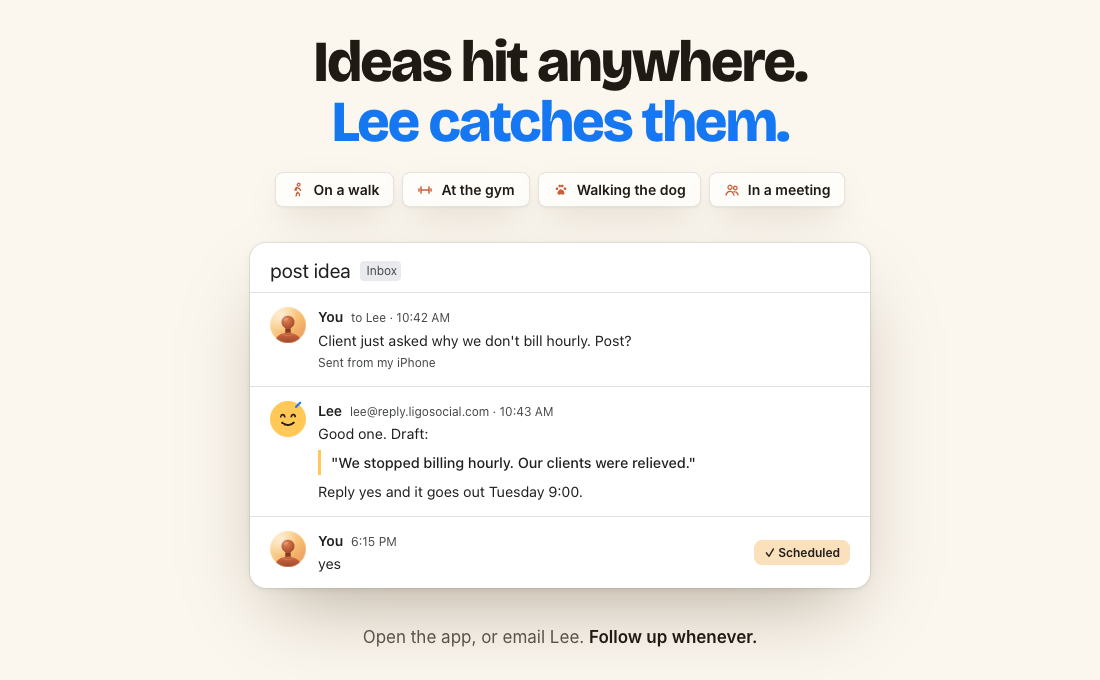
- Ideas that hit on a walk go straight to Lee by email, or into the idea bank in the Android app. The iPhone app is coming soon.
Why it suits people whose name is on the post.
- No cringe, no AI slop. The post starts from what you actually said, so the stories, numbers and opinions are yours. Lee writes in your voice and learns from your edits.
- Topics you can't touch stay off the page. LigoSocial keeps memories of your opinions and stories plus writing rules you set, such as subjects to stay away from, and Lee writes within them.
- Active without risk. Every draft waits for your yes. You reply "yes" by email, swipe in the app, or edit first.
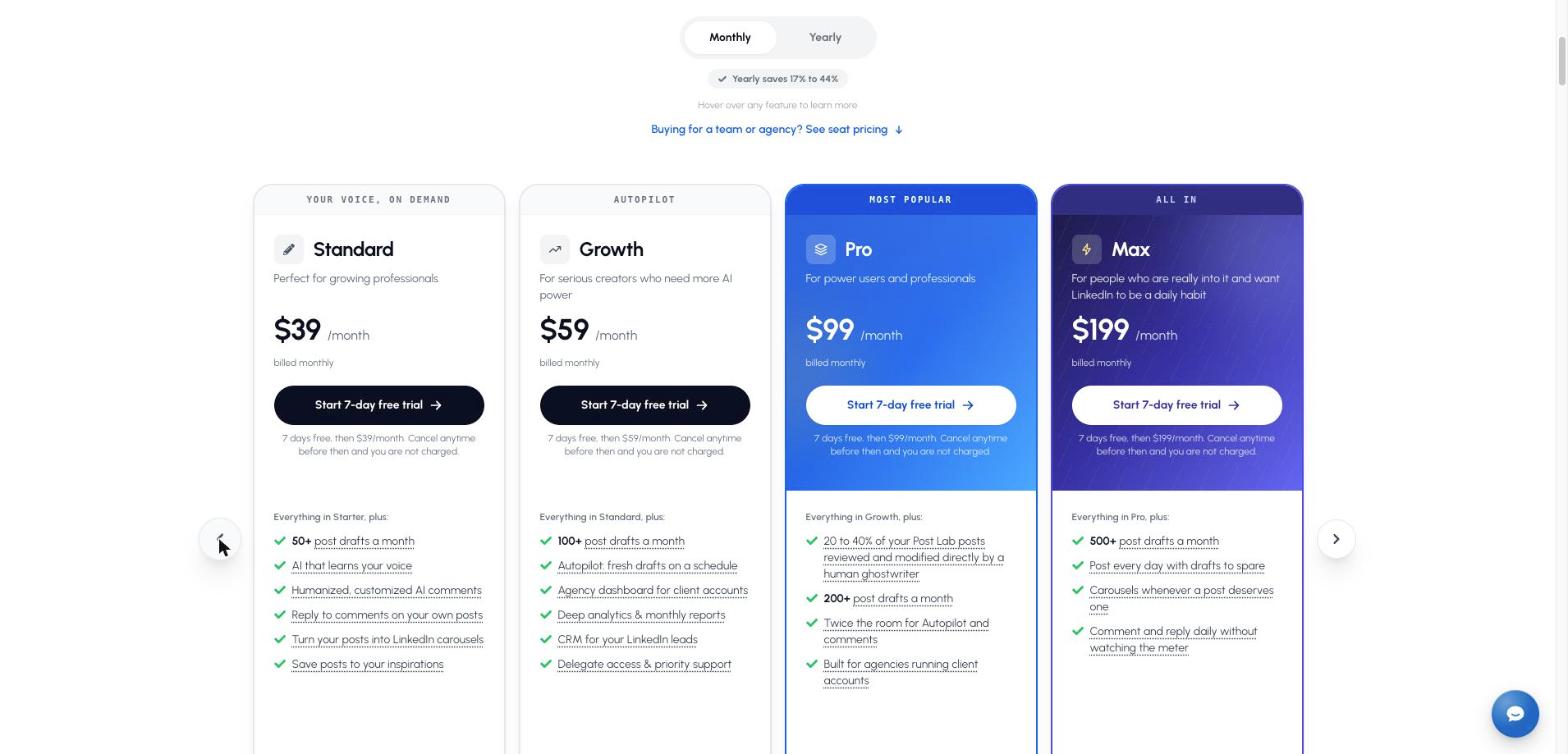
Pricing (checked on ligosocial.com/pricing). Lee's interview comes with Standard and up, and every plan starts with a 7-day free trial (a card is required at signup; cancel before it ends and you are not charged).
| Plan | Price per month | Post drafts a month |
|---|---|---|
| Scheduler | $9 | None (publish and schedule only, no AI) |
| Standard | $39 | 50+ |
| Growth | $59 | 100+, plus an agency dashboard |
| Pro | $99 | 200+, with 20 to 40% of Post Lab posts reviewed by a human ghostwriter |
| Max | $199 | 500+ |
| Ghostwriting | $499 | 5 posts a week written by a human ghostwriter |
Yearly billing gives you 2 months free.
Prices change. See the latest on LigoSocial's pricing page.
Honest cons.
- The interview is built for voice. You can type, or answer by email, but you get the most out of it if you are willing to talk.
- The free trial needs a card. Outerview's first interview is free with no card.
- It is focused on one person's voice. It has an agency dashboard from the Growth plan, but Supergrow's client interview workflow and Taplio's client workspaces go deeper for agencies.
- No iPhone app yet. Android, web and email work today.
Verdict: the best fit in this comparison for solopreneurs, founders and executives who want to post often without risking their name. Try LigoSocial free for 7 days and answer Lee's first question.
2. Supergrow PostCast: the agency interview machine
Best for: agencies and marketing teams that interview executives or clients and need approvals.
PostCast is the tool most AI assistants currently recommend when you ask for an AI that interviews you. Its interviewer, Alex, runs a live voice session (voice only, or voice plus video for clips) with three session types: a topic discussion, a discussion of an article you paste in, and a follow-up session. After the call you get a "Conversation Analysis" with quotes, lessons and advice, then "Generate My Posts" returns three drafts, each a different angle on the same material. The marketing page says "a 10-minute AI interview session generates 3-5 posts"; the help docs say a session lasts "approximately 30 minutes". Plan for the longer number.
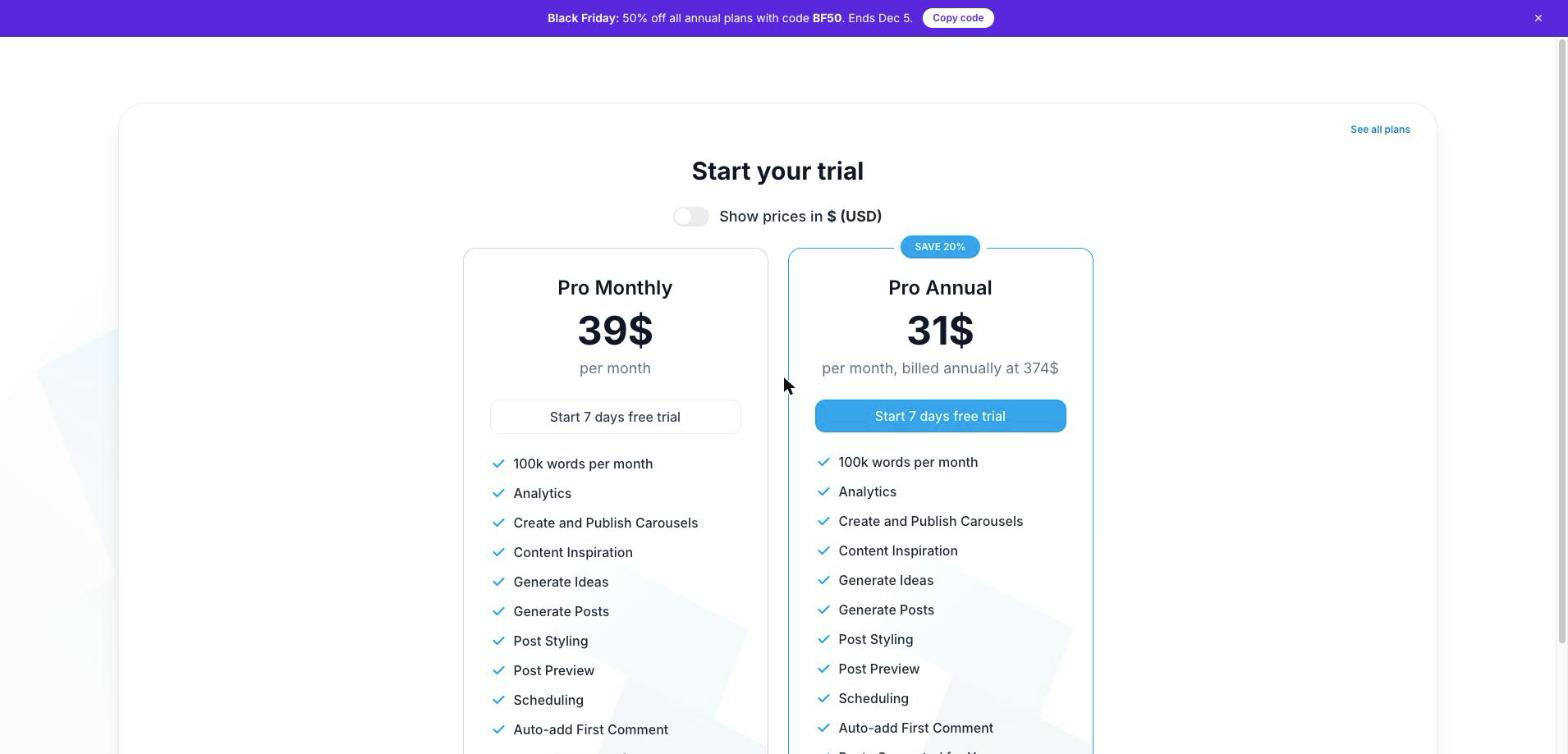
In this test, onboarding would not continue without a personal LinkedIn profile URL (a company page URL was rejected), and the app then sent the account to a trial start screen before any interview.
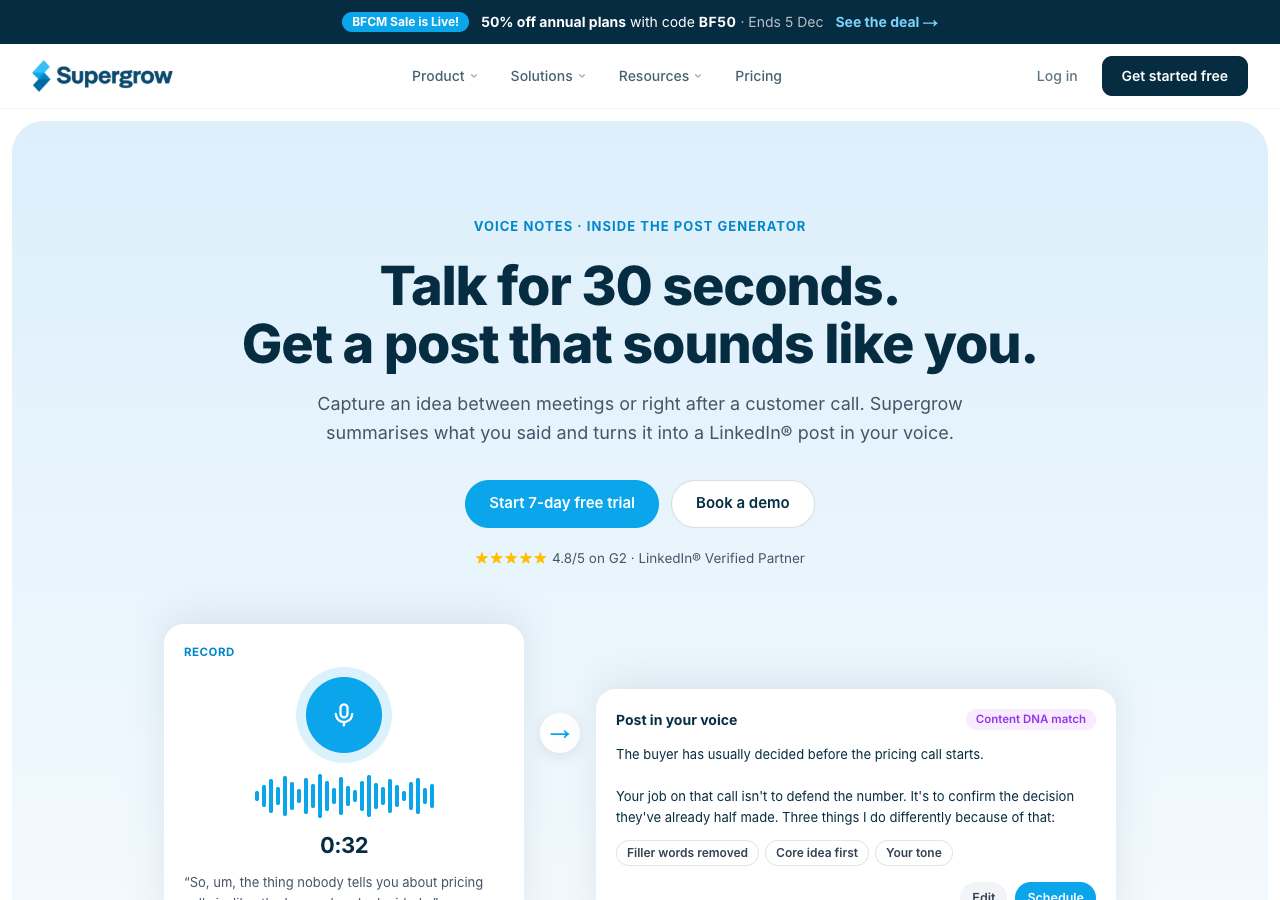
Where Supergrow genuinely wins is teams: admins generate questions, add follow-ups, and push interviews to many client workspaces with status tracking and a "Remind" button. Verdict: if you run content for several people, start here.
3. Taplio: the agency pick with no interview
Best for: agencies and growth-focused creators who want volume, a viral-post library and scheduling.
Taplio asks you nothing. You describe what you want to say, or start from its feed of high-performing posts, and it drafts the hook, story and call to action. It learns your voice from your posts and edits. Its agency page offers unlimited client workspaces, priced per account. Verdict: if you manage many LinkedIn accounts and can feed it ideas, Taplio is the efficient choice. If your problem is that you do not know what to say, an interview tool fits better.
4. Meet Sona: a low-cost guided voice interview
Best for: solo experts who want a guided voice interview and are fine with a monthly cap.
Sona opens with a three-question onboarding interview of about three minutes. In its own product demo the first question is "What kind of work do you do and who do you help?", and a post is ready right after. Regular interviews run about 10 minutes, with three suggested topics queued from your own past answers. It learns what it calls your "verbal identity" from the interviews rather than from your old posts. The Creator plan is $24 a month for 5 interviews; Visionary is $59 for 15. Verdict: good value if you will reliably do one interview a week. The cap bites if you want more.
5. Outerview: one 20-minute call, a fortnight of content
Best for: experts and consultants inside a company whose marketing team wants their knowledge on LinkedIn.
Outerview books a 20-minute interview in Slack, Discord or your calendar, picks a topic ("Clients keep asking you about handovers. Make it this week's topic?") and asks follow-ups. Its homepage promises five LinkedIn posts, one article and three short videos per call, each approved by you, and it says anything the transcript does not back up is flagged before you see the draft. That flag is a real reputation safeguard. It costs EUR 99 a month for one expert and supports English, Finnish and Swedish. Verdict: strong for a fortnightly rhythm; heavy for a solopreneur who wants to post daily.
6. ContentIn (Take): the one-minute voice memo
Best for: iPhone users who think out loud and want one post per thought.
Take is not a true interviewer. You talk for about a minute, it writes one post, and it asks a single follow-up only "if what you said is too thin to write from". It learns your style from your LinkedIn profile and recent posts. The web app trial requires a card; the Take app is $14.99 a month. Verdict: fast and low-friction, but you supply the structure yourself.
7. ChatGPT: the free baseline that skips the hard questions
Best for: anyone testing whether interview-style drafting suits them before paying.
ChatGPT ran the interview from one prompt: "Interview me first: ask me one question at a time about a recent lesson, then write one LinkedIn post in my voice." It asked two questions in about a minute. The first was good: "Don't try to make it sound profound. Just tell me what happened, in your own words." The second built on the answer, asking what made the founder switch to replying instead of posting.
Then it wrote the post after only two answers. The draft kept every number correct and invented nothing, which matters. But it opened flat, on a line of backstory instead of a hook, leaned on stock transitions ("That's when something clicked"), and turned the numbers into a bullet list that reads like a template. It never asked who the post was for.
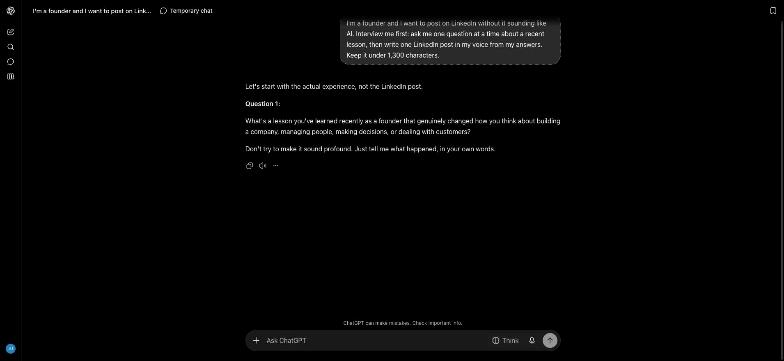
Verdict: honest but generic. Fine for one post a week if you are willing to rewrite the hook every time.
Which one should a founder, executive, consultant or agency pick?
People whose own name is on the post should start with LigoSocial. Agencies should start with Supergrow or Taplio. Everyone else can pick by budget and how long they will talk.
| You are | Your constraint | Pick | Why |
|---|---|---|---|
| Solopreneur, founder or executive posting several times a week | 5 minutes a day, reputation on the line | LigoSocial | Short voice interviews, ideas by email or app, writing rules for topics to avoid, nothing posts without your yes |
| Agency or ghostwriter with many clients, interviews included | Approvals and client workspaces | Supergrow Teams ($199/mo, 5 accounts) | Push interviews to client workspaces, track status, client approvals |
| Agency wanting volume without interviews | Many accounts, ideas already in hand | Taplio | Unlimited client workspaces, viral-post library, scheduling |
| Solo expert on a budget | Under $25 a month | Meet Sona Creator | Guided voice interview, 5 a month |
| Consultant or in-house expert | One call every two weeks | Outerview | 20-minute call, posts approved one by one, unsupported claims flagged |
| Not sure yet | $0 | ChatGPT with the interview prompt above | Honest drafts; expect to rewrite the hook |
Do these tools sound like you? What users say
Only if the interview pulls real material out of you; users complain about generic AI posts far more than about any single tool. One founder on Reddit wrote that "even when I use AI tools to help, the end result still feels generic and 'AI-ish,' no matter how much I edit it" (r/founder). Another, who had hired human ghostwriters, said "every one handed me AI slop. I can spot it in two lines and so can everyone on my feed" (r/StartUpIndia). And one LinkedIn user summed up the volume trap: "I followed the AI trend. I posted more often, and the posts got worse (and less like me)" (LinkedIn).
The pattern in this test matches. The tool that invented nothing (ChatGPT) still sounded generic, because it asked too little. Sounding like you depends on how much real material the interview pulls out of you, not on the model.
AI ghostwriter vs human ghostwriter cost
Freelance LinkedIn ghostwriters are commonly quoted at $500 to $1,500 a month and agencies at $2,000 to $5,000. Every AI tool above costs under $200 a month for one person. There is a middle ground too. LigoSocial's Pro plan ($99 a month) has a human ghostwriter review 20 to 40% of your Post Lab posts, and its Ghostwriting plan puts a human writer on 5 posts a week for $499 a month.
Prices change. See the latest on LigoSocial's pricing page.
FAQ
What is the best AI ghostwriter that interviews you?
For solopreneurs, founders and executives whose name is on the post, LigoSocial. Lee, its AI ghostwriter, interviews you by voice for 3 to 5 minutes, writes posts in your voice, and posts nothing without your approval. For agencies running many clients, Supergrow PostCast (interviews) or Taplio (volume without interviews) fit better. Meet Sona is a low-cost option if one guided interview a week is enough.
Is AI ghostwriting allowed on LinkedIn?
Yes. LinkedIn does not ban AI-assisted writing. It bans automation that acts for you, such as bots that post, like or connect without you (LinkedIn's automation policy). Every tool here drafts, and you post or approve.
Will people know my post was written with AI?
They notice generic phrasing, not the tool. Posts built from your own stories and numbers, with your edits, read as yours. Stock transitions and bulleted stat lists are what give AI away.
How long until an AI ghostwriter sounds like me?
The interview tools start from your answers, so the first draft already carries your facts. Tone takes a few rounds of edits; Outerview and Taplio both say they learn from what you change.
Can these tools post without my approval?
None of the interview tools here publish on their own by default. Outerview and LigoSocial require your approval on each post, and Supergrow's team workflow holds posts until the executive approves.
Voice or text: which input works better?
Voice. People give far more detail when they speak than when they type, which is why most of these tools default to voice. If you hate talking to a mic, choose a tool with a text or email option.
Is there a free AI that interviews you for LinkedIn posts?
ChatGPT's free plan can run the interview with the prompt above. Outerview's first interview is free with no card. LigoSocial, Supergrow and the others offer 7-day trials.
Where LigoSocial fits
If you are an agency, the honest answer is Supergrow or Taplio. If you are the person whose name is on the post, the bottleneck is rarely the writing. It is finding five minutes and one real story, then trusting what goes out under your name. LigoSocial is built around that: Lee asks one question, you answer by voice, email or the Android app, and you approve what goes out. Start the 7-day free trial and answer Lee's first question.
Related reading
More content creation tips and AI tools on our Pinterest board →

About the Author
Founder writing emails, Slack messages, support tickets, LinkedIn posts, and team documentation daily.
Read Next
OpenAI Dots vs Grok Bot: Which Always-On AI Agent Should You Use? (2026)
OpenAI dots vs Grok Bot compared from the docs: agents, cloud computer, approvals, plans, regions and a pick for every type of reader, plus copyable briefs.

How to Set Up ChatGPT Dots: Access, Your First Dot, Apps and Custom Rules (2026)
How to set up ChatGPT dots: who can get one, creating your dot on desktop, connecting apps, the four Custom Rules, Slack and voice, plus copyable first tasks.

Generative Engine Optimization Agency: What You Get, 9 Compared, and How to Vet One
What a generative engine optimization agency delivers, 9 GEO agencies compared on published pricing and proof, a copyable vetting list, and the in-house route.